
“You Just Have To Try”
This article was originally published in the Spring 2017 edition of the Rostrum.
When we think about bridging the gap, there are oh so many different things we can focus on in the debate and speech community. We would like to focus on one specific gap, and to do so, we will start with a story.
Like many of you, I (Shane) spent this past Presidents’ Day weekend at a debate tournament. As we moved into elimination rounds, I once again did what I often do and looked at the representation of women on the panels. What can be found? Too few women. Is this a problem? Yes. Absolutely, yes. Hasn’t this been addressed in years past? Yes. Then, why is this still a problem? That is the question we all need to examine.
Before going on, permit us a moment to explore why we are writing about this issue. As many of you know, providing balance on panels in elimination rounds— in terms of both women and people of color—is central to our philosophy at the Blake debate tournament that we host every year in Minnesota. While this article focuses on women, by no means do we want to diminish the importance of examining the number of people of color in elimination rounds. We can only hope that others will begin that discussion in the pages of Rostrum and elsewhere. But, for now, we will focus on the disproportionately few number of women often represented in elimination rounds.
Here, in an informal survey, are some numbers taken from three of the largest tournaments held on Presidents’ Day weekend. Check out the numbers across three tournaments and three formats of debate. These are not perfect numbers as there are likely errors on our part for assuming a gender given a name, but we hope they can serve to provide decent, if rough, estimates for the purposes of discussion.¹ And even if you use a margin of error to indicate the number of women on panels was higher, it is still fairly sad. Take a look below. We tend to think the numbers speak for themselves.2 There is a problem.
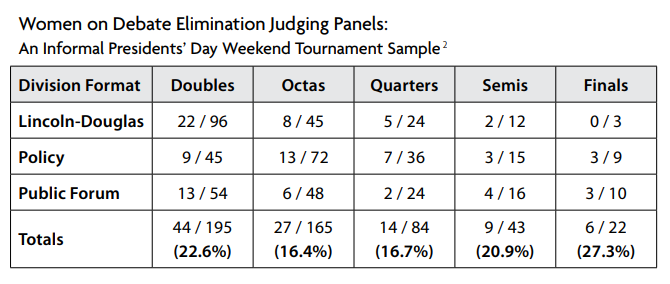
Why are the numbers so low? Policy tab rooms will tell you they are following mutual preference judging (MPJ) and that is the reason for these numbers. The search for the perfect panel of three “1” ranked judges is often given as the reason for these numbers.
We offer two responses.
First, tab staff should be instructed to look at the panels before release and search for women who can be added. It is worth the time it takes to scan the data for a few minutes. Women can be found.
Second, what about giving a mutual “2” or “3” ranked judge? If it adds a woman, can we agree to at least try that? It is notable that the one place where women were more greatly represented in a 3/6 semifinal and a 3/3 final was a more critical form of Policy Debate. But, again, that merely opens another discussion. What about Public Forum Debate? Public Forum is designed for community judges. There is no MPJ. Most tournaments offer a minimum number of strikes only. Why aren’t Public Forum panels more balanced? We don’t think it is because tab staff don’t care. Rather, we would argue it is because they are not thinking about it. Make it a priority! Shouldn’t Public Forum panels, given the orientation of the event, represent the community?
Here are some suggestions.
First, for tournament directors, tell your tab staff to look at this element—whatever your solution, tell them to look and try to balance gender on panels. Make a mindful and purposeful decision about the process and goals prior to the tournament.
Second, for coaches prior to the tournament, consider the basis on which you make decisions on strikes or ranks. What are the qualities that make a “problematic” judge? Be honest. When you do your MPJ rankings, take a second look and do a little math. How many women do you have in your first tier of judges? How about your second tier, etc.?
Third, for coaches and students during a tournament, consider this when you do strike cards. We had a moment in a late elim round of the TOC recently where we made our strike, and it was the only woman on the panel. Our coaching staff realized this and asked the students to reconsider given that fact. The students understood and the strike was changed. It was a moment of learning for everyone.
Fourth, for tournament directors, spend your hired judging money on women and people of color. Increase their presence in the pool. This is true for all forms of debate.
As we said initially, this is just the beginning of an important and much needed conversation. Discuss this with your coaching staff, with your coaching colleagues, with your students. Students, voice your ideas, for you are the folks who are developing your skills to persuade whomever is in the back of the room. The bottom line is: we need to eliminate the gap in our debate elimination judge panels. You just need to try.
R. Shane Stafford is Director of Debate at The Blake School in Minnesota. He also serves as a Board Member of the National Debate Coaches Association. Sandra J. Berkowitz, Ph.D., serves as Debate Coach at The Blake School in Minnesota. She also coaches the USA Debate team with her husband Shane.