
Regionalizing the Tournament of Champions
This article was originally published in the November 2010 edition of the Rostrum.
While at the Greenhill Invitational in Dallas, Texas, I spent quite a bit of time brainstorming topics to write about for this article, and one topic kept popping up throughout my deliberations over the weekend. How can we, as a community, host high quality tournaments such as the Greenhill Invitational in our own backyards?
This is not an article on how to provide superior hospitality (which in Dallas is simply the best, only compared to Mr. Tate’s Montgomery Bell Academy Southern Bell Forum). However, the aim of this article is to open a discussion about regionalizing the TOC bid process and, more specifically, how to create a system that allows our best students to debate in their own backyards more throughout the year.
Each and every May in Lexington, Kentucky, high school debaters from across the United States face-off in the Tournament of Champions. Besides high-level competition, there are also TOC Advisory Board meetings conducted, whose aim is to create a list of TOC Qualifying Tournaments for the following season. One discussion that I am repeatedly a part of, for better or worse, is the one that follows the meeting: which tournaments received bids and, more importantly, which tournaments lost bids to Tournament of Champions. It’s the discussion involving tournaments that lost their bids and why, that gave me the inspiration to write this article.
Regional debate is the backbone of our activity. In light of budget constraints and the current economic crisis, many teams have been told by their respective school that they can’t travel the exorbitant schedules they are used to doing. However, even though teams are traveling nationally much less, the organizations we value continue to keep their focus on nationalizing debate rather than regionalizing it. There are some schools that, because of their drive for TOC success, will never compete in regional tournaments. To overcome this competitive mentality and refocus discussions by our governing organizations, I propose the following system that aims to promote and reward regional debate. This system is a beginning, not an end, and is focused on generating discussion over regional debate practices. The following steps should be included in this new proposal:
Eliminate the current system of TOC bid designation/allocation. The current bid allocation systems exists without a concrete process for determining which tournaments receive bids and why certain tournaments receive them over others. Due to this lack of transparency, I advocate eliminating it.
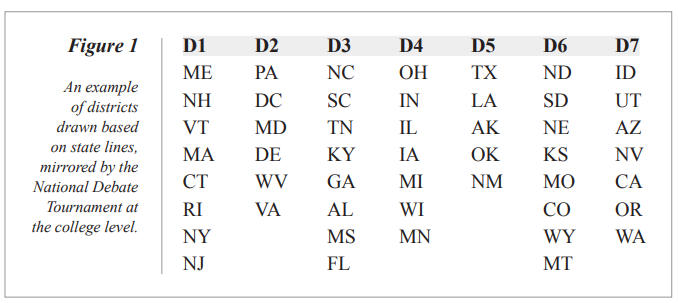
Create distinct competitive districts used to allocate new bids. These districts would be drawn based on state lines, and should follow a district example mirrored by the National Debate Tournament at the college level. An example of the districts can be seen above (Figure 1).
Elect regional bid directors. Right now the Advisory Board is made up of members of the community who are appointed by the University of Kentucky. The new system would allow for individual regions to appoint directors on a two- to three-year term. These bid directors would be responsible for evaluating tournaments in their region and advising the TOC committee as to which tournaments they’d like to approve for TOC bid allocation. This would allow for a more local approach to bid allocation and allow for each tournament to have a proper review prior to the May committee meeting.
Redistribute bids according to the new advisory committee recommendations. The system we utilize now has very strong concentrations of bids in the South and Midwest, while having weak spots in the Pacific Midwest and Northeast. The new system would allocate equal bid distribution among the seven districts above. This allocation would resemble the model below. Each district would host the following tournaments:
2 – Octafinal Tournaments
2 – Quarterfinal Tournaments
2 – Semifinal Tournaments
1 – Final TournamentRedefine qualification procedures. Currently, guaranteed TOC attendance requires, at a minimum, two bids received from designated tournaments. The new system would change this bid allocation from two bids necessary to attend the Tournament of Champions and change it to three bids necessary to attend the TOC. The increased bids necessary to compete are based on the number of available bids in each region. Last year's data shows that 48 teams who competed at the TOC accumulated three bids during the year. In a field of 72 teams, that allows for 24 more teams to be accepted under the new formula.
I believe the above process is a step in the right direction for making the high school debate community more sustainable in the future. The current decline in competitive debate is a trend we must stop immediately. We must remove our national circuit focus for our debate programs and turn it inward to help inject energy and competition back into our regional debate community.
Steps need to be taken in the coming years for our activity to survive at a national scope. If we refuse to work to build up our regional debate practices, the backbone that our activity relies on will become extinct; and debate, as we know it, will slowly disappear.
Brian Manuel is the assistant debate coach for the Lakeland District Debate Team in Shrub Oak, NY and the College Prep School in Oakland, CA. Brian coaches college debate for Harvard University in Cambridge, MA and does research and marketing for their debate company, Planet Debate. Aside from coaching, Brian also directs the James M. Langan Speech & Debate Invitational at Scranton High School and will host the 2011 National Debate Coaches Association National Championship in Scranton, PA from April 15-18
